Emmy Award Winner · Founder, ORAI — AI-Augmented Filmmaking Academy
Welcome. If you are reading this, you are considering becoming an author — not a user of tools, an author of cinema. That is the only thing ORAI teaches, and it is the rarest skill of this century.
I have spent my life on real sets — from engineering rooms in Detroit to Sundance premieres, from Showmax series to the first hybrid-AI films ever shot on this continent. What I learned is now a system: five layers, twelve frameworks, one standard. In this lesson I will show you what the academy offers — and then, instead of telling you what AI-Hybrid filmmaking is, I will show you one scene going through the entire pipeline.
Everything below was made with the actual ORAI pipeline — real AI-generated boards, a real frame, real motion. The scene is from the world of The Fifth Nomoli, our hybrid-AI feature shot in Sierra Leone. Step through the five stages.
Intelligence — the story decides everything
ORAI · the production brain
EXT. FREETOWN COAST — FIRST LIGHT
MUSA, a young fisherman, stands where the tide left him. He opens his hand.
The NOMOLI — a small carved stone, older than any map of this coast — wakes in his palm. Its glow answers the sunrise.
MUSA (quiet)
Who left you for me?
What happened here: before a single image exists, the scene is authored — world, character, intention. In the ORAI stack, the story layer drives every layer below it. AI never decides what the scene means. You do.
Visual development — the scene learns to be seen
AI-generated storyboards · minutes, not weeks
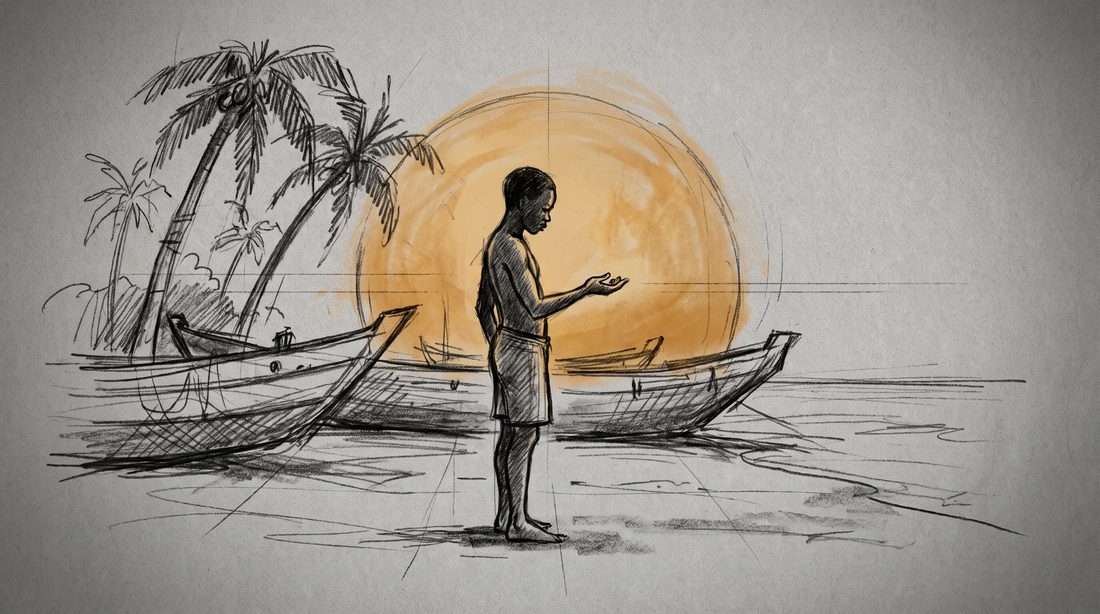
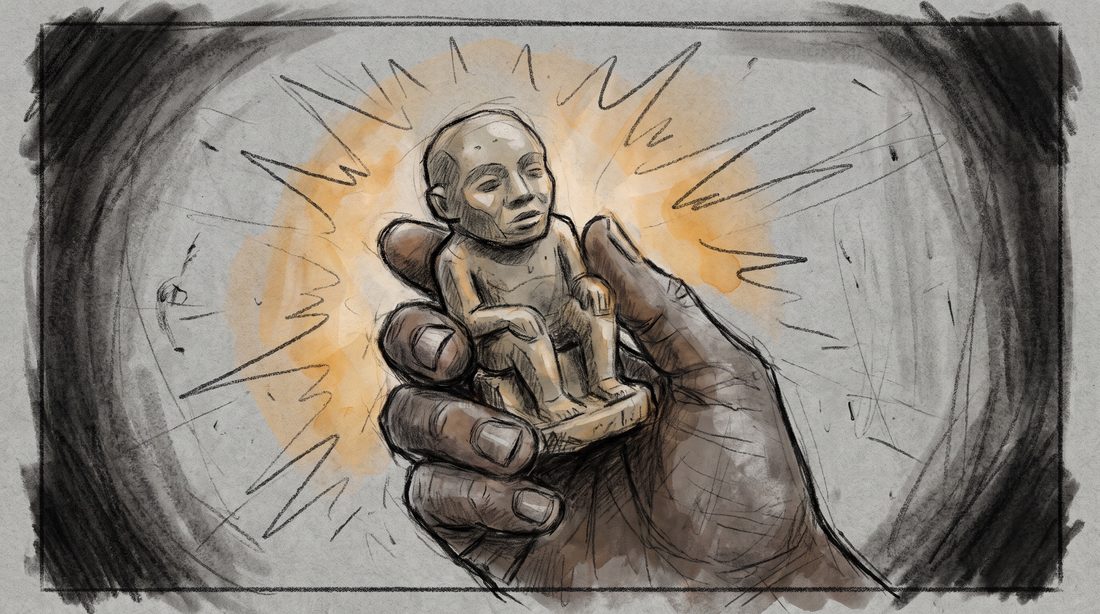
Board 01 — Wide · Musa at first lightBoard 02 — ECU · the stone wakes
What happened here: the written beat became boards through an AI image model, directed by human shot language — wide, then extreme close-up. On a traditional production this is days of a storyboard artist’s time. Here it is minutes — and the director iterates as fast as they can think.
The frame — cinematography before the shoot
Lens language · light · the look, locked early
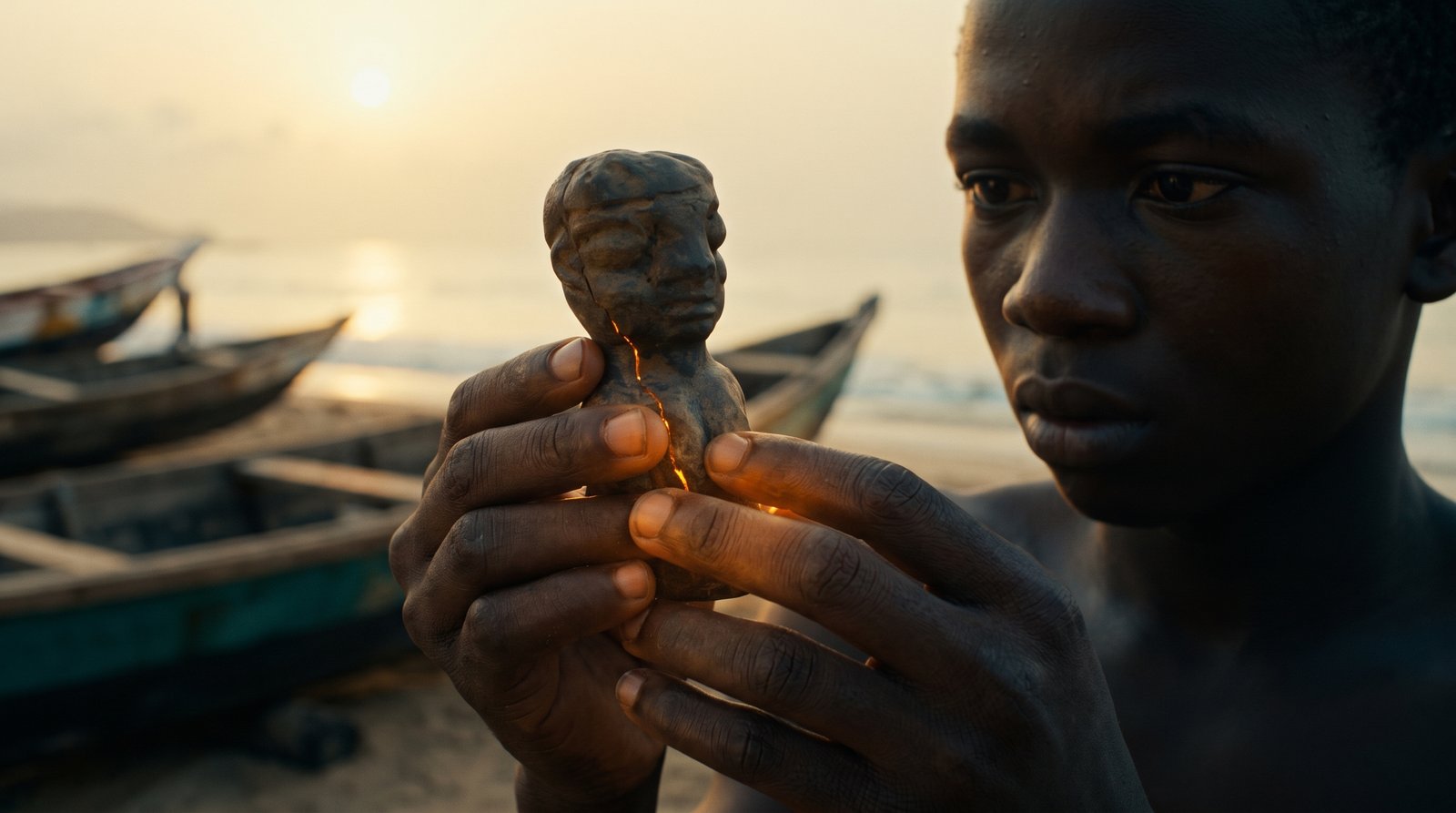
What happened here: the board became a finished frame — 35mm anamorphic language, golden first light, the glow seeping through the crack. And look closely at the stone: that is the actual Nomoli prop from our set, placed into the frame by the model from a reference photograph. This is how ORAI locks a film’s look before a single shoot day — real objects, real continuity, before the crew ever arrives.
Motion — the frame breathes
Augmentation · the connective layer
ORAI · AI MOTION · GENERATED
What happened here: the locked frame became a real AI-generated motion clip — a push-in you barely feel, the stone’s glow breathing like a heartbeat through the crack. This is the augmentation layer working: on the full stack this stage runs through AI video models and the Ronin 4D on real sets, and the academy teaches you when to generate motion, when to shoot it, and how to make the seam invisible.
Authorship — the human signature on every layer
ST-02 · the standard the whole pipeline answers to
The story
A human chose Musa, the coast, the question he asks the stone. The machine proposed nothing.
The shots
A human chose wide-then-close — arrival, then intimacy. Shot grammar is authorship.
The light
A human demanded dawn, 35mm anamorphic, the glow reflected in his eyes. Taste is authorship.
The motion
A human chose restraint — a push-in you barely feel. Knowing what not to move is authorship.
This is the whole lesson: every artifact you just saw is documented in a Production Bible and certified against ST-02, the Authorship Standard — the same gate every film must pass to premiere at First Light. AI made the pixels. An author made the film.
Your first assignment
“AI will not replace filmmakers. Filmmakers who understand AI will replace those who do not.”
You have now seen the method once. The academy teaches you to command it.